
That half-squeezed tube sitting on your sink still holds a usable amount of toothpaste when it hits the bin. After all, rolling and twisting a tube leaves product trapped in the folds near the bottom. A toothpaste dispenser removes that waste, and over a year the savings can cover the cost of the dispenser itself.
At Made Minimal, we focus on practical bathroom products designed to reduce everyday waste and unnecessary household spending. We’ve looked at pricing and waste across common bathroom accessories, comparing what a household spends with and without one. This guide uses current tube prices and typical usage numbers, rather than rough guesses.
By the end, you’ll know how much toothpaste gets wasted through squeezing and what a dispenser saves you over a year. You’ll also see whether it fits your bathroom, with a few options from our Brisbane-based store worth checking out.
How Your Bathroom Accessories Waste Toothpaste Every Day
A standard tube holds onto more product than people realise once it’s been rolled and flattened. Most households give up on a tube well before it’s empty, open a new one, and repeat the cycle (yes, that flattened, twisted mess at the back of the drawer).
This happens across nearly every tube in the house rather than just the one by the sink. Kids’ toothpaste, travel tubes, even the pricier whitening kind all get replaced early for the same reason. Multiply that across a household replacing 10 tubes a year, and early replacement becomes a built-in cost nobody questions.
Can a Wall-Mounted Dispenser Stop That Waste?
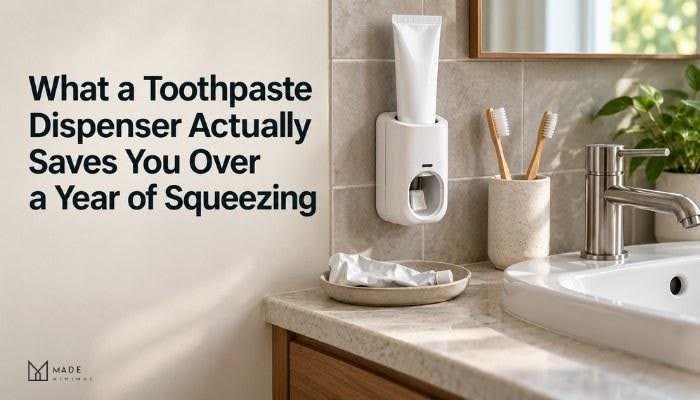
Yes, a wall-mounted dispenser stops nearly all of that waste. It pushes toothpaste out from a sealed chamber instead of relying on a squeeze. There’s no folding or rolling, and no paste gets trapped once the tube runs dry. Honestly, the first time you use one, it feels almost too easy, like you’re cheating the system somehow.
A press-activated design empties a tube fully before you need to load a new one. That single change closes the gap between what you pay for and what you use. Soap dispensers work on the same basic idea, which explains why most bathrooms already have one by the sink.
What Household Savings Look Like Over a Year
Toothpaste costs vary by brand and type, but even a small amount left behind adds up over a year. A dispenser may help people use more of each tube before replacing it.
Here’s a simple example using 10 tubes a year at $5 each:
| Squeezing a Tube | Using a Dispenser | |
| Tubes bought per year | 10 | 9 |
| Example price per tube | $5 | $5 |
| Yearly toothpaste spend | $50 | $45 |
| Example yearly saving | $0 | $5 |
In this example, getting enough extra use from each tube to avoid buying one replacement saves about $5 a year. With an $8 toothpaste, the same one-tube reduction would save $8 a year.
The exact saving depends on the toothpaste price and how much your household usually leaves in each tube. So, treat these figures as an example rather than a guaranteed saving.
Finding Bathroom Space for a Dispenser in a Minimalist Bathroom
Money aside, a dispenser only makes sense if it suits your bathroom space. Most wall-mounted options sit flush against tile with no-drill adhesive, so they take up less room than a tube left lying on the counter. We’ve seen bathrooms where the counter is basically a toothpaste graveyard, tubes rolled up and abandoned everywhere.
A minimalist bathroom benefits most from this kind of swap since clutter is exactly what that style tries to avoid. One sealed dispenser replaces several loose tubes, which keeps the sink area looking deliberate rather than accidental. It fits a simple bathroom the same way a soap dispenser already does, as one fixed point instead of scattered bottles.
Key Features Worth Checking Before You Buy
We’ve installed several dispensers in different bathrooms, and mounting strength, dispensing control, refill access, and cleaning ease made the most noticeable differences. Not every dispenser suits every setup. A good dispenser should match your bathroom’s existing fixtures, work with any toothpaste brand, and mount without drilling into tile.
The following details can help you choose:
- Any-Brand Fit: Every dispenser should work with any toothpaste tube, regardless of size or tube design. Most models adjust internally to grip different tubes, so you don’t need to match a specific brand.
- No-Drill Mount: Adhesive backing means no damage to tiles or walls during setup. You’ll be done installing in a few minutes flat.
- Finish and Material: Grey and black options suit a modern bathroom while complementing other fixtures. Picking a finish that suits the space keeps the whole area looking considered.
- Fair Price Range: $15 to $20 is typical for this kind of accessory. Paying much more usually buys a feature you won’t use day-to-day.
Across these four points, the common thread is fit rather than flash. A dispenser that matches your tube, your wall, and your budget will outperform one that just looks good in a photo.
Made Minimal‘s wall-mounted option checks each of these boxes, available in grey or black with no-drill adhesive backing and a price under $20.
Is a Toothpaste Dispenser Worth the Switch?
Yes, for most households, the switch can pay for itself within 1.5 to 2 years. The upfront cost sits around $15 to $20, while reduced toothpaste waste can save about $10 a year.
Beyond the money, a dispenser tidies up the sink and fits neatly into a minimalist bathroom without adding clutter.
That combination of value and balance between function and tidiness makes this one of the easier upgrades to justify. Cut down on wasted toothpaste with a wall-mounted tube squeezer. Contact Made Minimal today to order yours.