

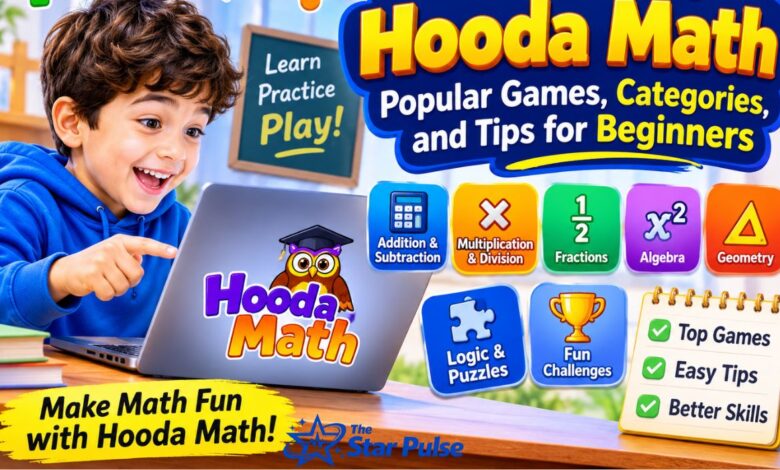
Online educational games have changed how students practice mathematics. Instead of depending entirely on textbooks and traditional worksheets, learners can now improve their skills through interactive activities. Hooda Math is a popular educational gaming platform that combines entertainment with mathematical learning. It offers different types of games covering addition, subtraction, multiplication, division, fractions, algebra, geometry, and logical reasoning. Students can choose activities according to their grade level and mathematical abilities. Beginners can also explore different categories without installing complicated software or purchasing a subscription. Whether someone wants to improve calculation speed, understand challenging concepts, or enjoy educational puzzles, Hooda Math provides several opportunities to practice. Understanding its features, popular games, and playing methods can help students make better use of this online learning resource.
What Is Hooda Math?
Hooda Math is an online educational gaming website that provides free mathematical games and interactive learning activities. It was created by a middle school mathematics teacher who wanted to make mathematics more enjoyable for students. The platform has developed into a collection of more than 1,000 games, with activities covering different educational levels. Students can explore basic arithmetic, fractions, integers, algebra, geometry, and problem-solving challenges. Unlike traditional learning materials, these games allow users to practice mathematical concepts while completing interactive tasks. The website also includes puzzles, escape games, and other entertainment activities. This variety makes Hooda Math useful for students who want to combine learning with entertainment. Its browser-based format also makes getting started relatively simple.
How to Access the Hooda Math Website
Accessing Hooda Math does not require advanced technical knowledge. Beginners can open their preferred internet browser and visit the official website at HoodaMath.com. After the homepage loads, users can explore different sections featuring games organized by grade, mathematical subject, and playing style. Select a category that matches your interests and browse the available activities. Once you find a suitable game, click its title or image to open it. Most games can be played directly through the browser without downloading a separate application. Users should make sure they have a stable internet connection to avoid interruptions. Reading the instructions before starting is also helpful because different games may have different controls and objectives.
Choose Games According to Your Grade Level
One helpful feature of Hooda Math is its grade-based organization. Students can explore activities designed for different educational stages instead of choosing random games. The available categories cover kindergarten, elementary school, middle school, and high school learning levels. Younger students can practice counting, addition, subtraction, and number recognition. Older learners can explore multiplication, fractions, integers, algebra, and geometry. Selecting the correct grade level helps students avoid activities that are too difficult or too simple. Parents and teachers can also use these sections to recommend appropriate practice. Beginners should start with familiar mathematical concepts and gradually move toward more challenging activities as their confidence and understanding improve.
Explore Addition and Subtraction Games
Addition and subtraction are essential mathematical skills, and Hooda Math offers interactive activities to help students practice these operations. Popular examples include Math Duck, Jet Ski Addition, Skater Math, and Ducky Race Subtraction. These games make calculations more interesting by combining questions with different challenges and interactive elements. Instead of completing ordinary worksheets, players may need to select correct answers, move through obstacles, or finish tasks using arithmetic. Such activities can help younger learners become more comfortable with numbers and basic calculations. Beginners should concentrate on answering correctly before attempting to improve their speed. Regular practice can strengthen their understanding and prepare them for multiplication, division, and more advanced mathematical subjects.
Practice Multiplication and Division
Multiplication and division are important topics that require regular practice. Hooda Math provides different games that help students become familiar with times tables, factors, and number relationships. Activities such as Flappy Factors, Tug Team Tractor Multiplication, and Division Derby offer opportunities to practice calculations through interactive challenges. Multiplication games can help learners remember multiplication tables, while division activities encourage them to understand how numbers can be separated into equal groups. Beginners should review basic multiplication facts before attempting faster games. It is also important to understand incorrect answers instead of repeatedly guessing. Combining these activities with classroom exercises can make multiplication and division easier to understand and remember.
Learn Fractions and Integers Through Games
Fractions and integers can be challenging because they introduce mathematical concepts that are different from ordinary whole-number calculations. Hooda Math provides dedicated activities to help students explore these subjects. Examples include Fractions Timed Tests, Snow Sprint Multiplying Fractions, Integer Tilt, and Orbit Integers. Fraction games help learners practice numerators, denominators, and mathematical operations involving parts of a whole. Integer activities provide opportunities to work with positive and negative numbers. Beginners should understand the basic rules of these subjects before selecting advanced challenges. Practicing through interactive games can reinforce classroom lessons and help students become more comfortable with mathematical relationships. It is particularly useful to review mistakes after completing each activity.
Discover Algebra and Geometry Games
Algebra and geometry introduce students to more advanced mathematical thinking. Hooda Math offers activities that encourage learners to recognize patterns, understand shapes, and solve problems. Some examples include Sand Grid, Target SOE, and Otter Rush Exponent Expressions from its algebra-related collection. Geometry activities include Transformation Golf, Dark Room, and DuBlox. These games provide different ways to explore mathematical ideas beyond ordinary calculations. Students beginning algebra should first understand variables, expressions, and simple equations. Geometry learners can start by identifying basic shapes, angles, and their properties. Choosing games that match their current knowledge helps students develop confidence before moving toward more complicated challenges.
Try Logic, Escape, and Puzzle Games
Hooda Math is not limited to traditional mathematics exercises. Its website also features logic games, escape challenges, and puzzles that encourage careful thinking. Popular activities include 2048, Sugar Sugar, Mouse Trap, and Goat Crossing. Escape games usually require players to examine their surroundings, discover clues, and solve connected puzzles to progress. These activities can develop observation, patience, strategic thinking, and problem-solving habits. They are particularly interesting for students who enjoy challenges but do not always find ordinary calculations entertaining. Although these games provide useful mental exercises, they should be treated as supplementary entertainment rather than replacements for structured mathematics lessons.
Understand the Game Controls
Before starting a new Hooda Math game, beginners should understand how its controls work. Different activities use different interaction methods depending on their design. Some require clicking numbers or objects, while others use keyboard arrows, mouse movements, dragging, or touchscreen gestures. Racing-style games may combine mathematical questions with movement controls, whereas puzzle games often require players to arrange objects correctly. Most importantly, look for the instructions or How to Play section before beginning. Understanding the objective can prevent unnecessary mistakes and make gameplay more enjoyable. If a game seems difficult, review its instructions and try again rather than immediately moving to another activity.
Use Hooda Math on Chromebooks and Mobile Devices
Another useful feature of Hooda Math is its browser-based accessibility. Students can generally visit the website through compatible desktop computers, laptops, Chromebooks, and mobile devices. This makes it convenient for classroom practice and home learning. Chromebook users can access suitable activities through their regular internet browser without installing a separate desktop application. Mobile users should select games that work comfortably with touchscreen controls because not every activity provides an identical experience across devices. A reliable internet connection is also important for smooth gameplay. However, some schools restrict access to gaming websites through their internet filters, meaning availability can depend on individual school policies.
Explore Additional Learning Tools
Hooda Math offers more than ordinary online games. Its educational resources include Math Timed Tests, Math Tutorials, and Math Manipulatives. Timed tests help students practice calculations within a limited period, making them useful for improving arithmetic fluency. Tutorials provide additional explanations of mathematical concepts, while manipulatives offer interactive ways to explore different subjects. Teachers can use these resources for classroom warm-ups, revision sessions, and additional practice. Students can also use them independently when they want to review a topic outside school hours. Exploring multiple resources helps learners understand mathematical concepts from different perspectives rather than depending on one type of exercise.
Beginner Tips for Better Results
Beginners can make their Hooda Math experience more productive by following a few practical strategies. First, select games that match your current mathematical ability. Starting with familiar topics helps build confidence before attempting advanced challenges. Second, read the instructions carefully and understand the objective. Third, focus on accuracy rather than rushing to complete levels. Fourth, practice regularly in short sessions instead of spending excessive time on one activity. Fifth, review incorrect answers to identify areas that need improvement. Students can also switch between arithmetic, puzzles, and subject-based activities to maintain interest. Connecting the answers discovered in games with classroom lessons makes online practice more meaningful.
Benefits and Limitations of Hooda Math
Hooda Math provides several advantages, including free games, multiple mathematical categories, grade-based browsing, and browser compatibility. Its variety makes repetitive practice more enjoyable, particularly for students who prefer interactive activities. The platform also offers puzzles and logic games that encourage problem-solving. However, online games cannot replace classroom teaching, detailed explanations, or personalized support from teachers. Some activities focus more on entertainment and reaction speed than mathematical understanding. Internet access is necessary, and school network restrictions may affect availability. Parents should also encourage balanced screen time and age-appropriate game selection. When used as an additional learning resource, Hooda Math can support mathematical practice while keeping students interested.
Final Thoughts
Hooda Math is a useful online platform for students who want to practice mathematics through interactive games and educational activities. From basic addition and subtraction to fractions, integers, algebra, and geometry, its categories provide different opportunities for learners at various educational levels. Beginners can get started by visiting the official website, selecting a suitable category, and following the instructions provided with each activity. Its free browser-based games and additional educational resources make it convenient for home and classroom practice. However, the best results come from combining online activities with traditional lessons, reviewing mistakes, and practicing consistently. Used correctly, Hooda Math can make mathematical learning more enjoyable and help students develop confidence.
FAQs
1. What is Hooda Math?
Hooda Math is a free online educational gaming platform featuring mathematics activities, puzzles, and interactive learning resources. It covers subjects such as addition, subtraction, multiplication, division, fractions, integers, algebra, and geometry. Its games are designed for different grade levels, from kindergarten through high school.
2. Is Hooda Math free to play?
Yes, Hooda Math provides free access to its games without requiring users to purchase a subscription. Most activities can be opened directly through a web browser without downloading additional software. Optional Club Hooda features are available, but they are not necessary for basic gameplay.
3. Can I play Hooda Math at school?
Students can access Hooda Math on compatible school computers and Chromebooks when their school’s internet policies allow it. The platform offers browser-based games that generally do not require separate installations. However, some schools block gaming websites, so availability depends on individual network restrictions.
4. Which Hooda Math games are best for beginners?
Beginners can explore Math Duck, Jet Ski Addition, Skater Math, and Ducky Race Subtraction. These activities provide opportunities to practice basic arithmetic. Students who already understand simple calculations can move toward multiplication, fractions, integers, and introductory algebra games.
5. Does Hooda Math improve mathematical skills?
Hooda Math can support mathematical development by providing repeated practice with calculations, number relationships, and problem-solving activities. Its interactive format can encourage concentration and interest in learning. However, students should combine gameplay with classroom instruction, independent study, and regular practice for stronger results.