

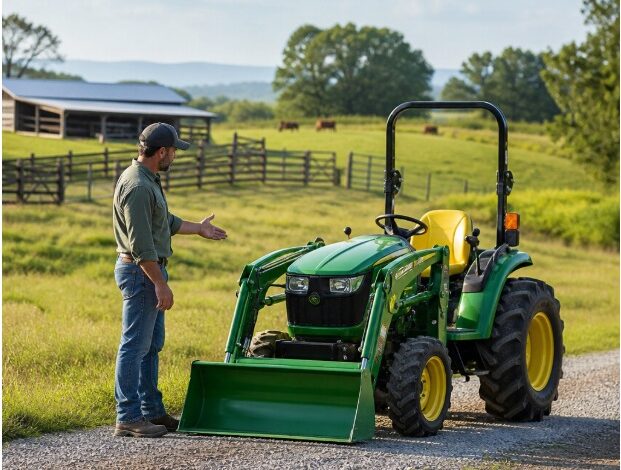
Most people buying their first tractor get the decision backwards. They start with horsepower, fall in love with a cab model, and only later discover the machine is too heavy for their wet paddock gateway, or too light to lift a round bale off a trailer. The better order is: list the jobs, choose the implements those jobs need, then buy the smallest tractor that will run them comfortably. Do it that way and you end up with a machine that earns its keep for fifteen or twenty years instead of one that sits in the shed because it is awkward to use.
What follows is a practical sizing and ownership guide for anyone with a few acres, a hay patch, or a rural property that has outgrown a garden mower.
Start with a job list, not a spec sheet
Write down every task you expect the tractor to do over a full year, and be honest about frequency. A machine that grades your lane twice a year does not need to be sized for grading; it needs to be sized for the job you do every week. Typical lists look like this:
- Mowing rough pasture or verges with a rotary cutter
- Moving round or square bales, feed bags, gravel and fence posts with a loader
- Light tillage: box blade, disc harrow, rotary tiller for a garden plot
- Post-hole digging and fencing work
- Snow or mud: blade, blower, or just hauling in bad conditions
- Hay: mowing, tedding, raking and baling if you cut your own
Now mark the single heaviest-duty item on that list. That one task — usually either bale handling or baling — sets your minimum machine. Everything else will follow along.
What horsepower bands actually mean in the field
Horsepower numbers are quoted at the engine, but the figure that matters is PTO horsepower and, for loader work, weight and hydraulic flow. A rough field guide:
Sub-compact, roughly 20–25 hp
Excellent for an acre or three of mown lawn, light landscaping, a mid-mount finishing mower and small loader work. It will run a 4–5 ft rotary cutter in grass but will bog in heavy brush. Light enough to cross a lawn without rutting it, which matters more than people expect.
Compact, roughly 25–45 hp
The sweet spot for most small farms. At the top of this band you can run a 6 ft cutter, a tiller, a post-hole digger and a loader that will handle a four-foot round bale if the machine is properly ballasted. Four-wheel drive is close to essential here; the front axle is doing real work under a loaded bucket.
Utility, roughly 45–75 hp and up
Now you are in hay territory. A small round baler, a disc mower, a tedder and a three-point rake all want a tractor with the PTO power and the rear-axle weight to stay planted on slopes. If you make your own hay and handle big bales, do not try to squeeze into a compact. Underpowered baling is slow, hard on the clutch and hard on the operator.
One more trade-off worth naming: cab versus open station. A cab is a gift in January and in a dusty cutting job, but it adds height and width. Measure your barn door, your lowest tree limb and your tightest gateway before you commit.
Buy the package, not just the tractor
Implements routinely cost a significant share of what the tractor does, and a mismatched implement is worse than none. A cutter wider than your rear tyres leaves uncut strips on turns; a box blade too light for your tractor just skates over hardpan. This is why pre-built tractor packages — tractor, loader, and one or two matched implements — tend to be good value for a first-time buyer. The dealer has already confirmed hitch category, PTO speed, hydraulic flow and ballast requirements fit together.
Ballast deserves its own sentence. A loader-equipped tractor without rear weight is a tipping hazard and chews up front tyres. Rear implements, a ballast box or loaded tyres are not optional extras; they are part of the machine’s design.
Where a dealer relationship pays off
Specification advice is only half of what you are buying. The other half is who answers the phone when a hydraulic hose bursts on a Friday in hay season. Before signing anything, ask what service capacity looks like in your area, whether common wear parts are kept on the shelf, and how repairs are handled during the busy months. Across Kentucky, Tennessee and Indiana, growers working with an authorized Kubota farm equipment dealer such as H&R Agri Power can line up a new or used tractor, a pre-built or custom package, and genuine Kubota parts through the same parts counter and service department — and that continuity matters when a filter, seal or belt needs replacing in a hurry. The same workshops handle general tractor, mower and baler parts, with lawn mower repair available at locations including Owensboro, Kentucky, which is useful if your acreage kit and your yard kit both need looking after.
Genuine parts: when it matters and when it doesn’t
Not every bolt needs to come in branded packaging. Generic hardware, grease and some hoses are fine. But there are places where genuine parts are worth the premium:
- Filtration. Hydraulic and engine filters are specified to a particular micron rating and bypass pressure. A cheap filter that bypasses early sends debris straight through your hydrostatic transmission.
- Seals and gaskets. Dimensional tolerance is everything; a near-fit seal is a slow leak.
- Clutch, PTO and driveline components. Failure here is expensive and often takes other parts with it.
- Anything still under warranty. Document what you fit and when.
Keep a small shelf of consumables: engine and hydraulic filters, an air filter, a spare set of mower blades or baler belts’ lacing, fuses, and a couple of hose assemblies in the sizes you break most. Label them. The point of a parts shelf is that you do not have to think at 6am.
A seasonal checklist that actually gets done
Short lists get followed. Long ones get ignored. Use these four.
- Spring: change engine oil and filter, check coolant strength, grease every zerk on loader and implements, inspect tyre pressures (uneven fronts are the usual culprit for poor steering), test lights and brakes.
- Before hay: replace hydraulic filter, inspect PTO shaft guards and shear bolts, check mower blades and skid shoes, run the baler empty and listen, replace any hose with cracked outer sheath.
- Late summer: clean the radiator screen properly — chaff build-up is the leading cause of hot-weather shutdowns — and re-torque wheel bolts.
- Winter lay-up: top off fuel and add stabiliser, grease exposed cylinder rods, store batteries charged, and lower implements onto timber rather than bare soil.
Log hours and jobs in a cheap notebook kept in the cab. Resale value climbs noticeably when you can hand a buyer a service history, and a technician diagnosing an intermittent fault will thank you for it.
Thinking a few seasons ahead
Small operations are picking up tools that used to belong only to big acreage: GPS guidance on hired contractors’ kit, moisture sensors on balers, telematics that flag a service interval. If you want a sense of where that is heading before you commit to a platform, the state of U.S. precision agriculture report is a reasonable starting point for understanding adoption rates and what the technology is realistically doing on working farms.
The other thing worth planning is what happens to the output. A tractor that lets you cut your own hay, grow a serious vegetable plot or raise more stock also creates a storage problem, and the people who manage that well tend to think about keeping a harvest properly stored at the same time as they think about the machinery. Equipment and storage are two halves of the same self-sufficiency problem.
The short version
Size from the heaviest recurring job, not the rarest one. Match implements to hitch, PTO and hydraulic capacity before you buy anything. Ballast the back. Spend on filters and seals, save on hardware. Keep a parts shelf and a notebook. And choose a dealer by how their parts counter and workshop behave in July, not by how the showroom looks in February.