

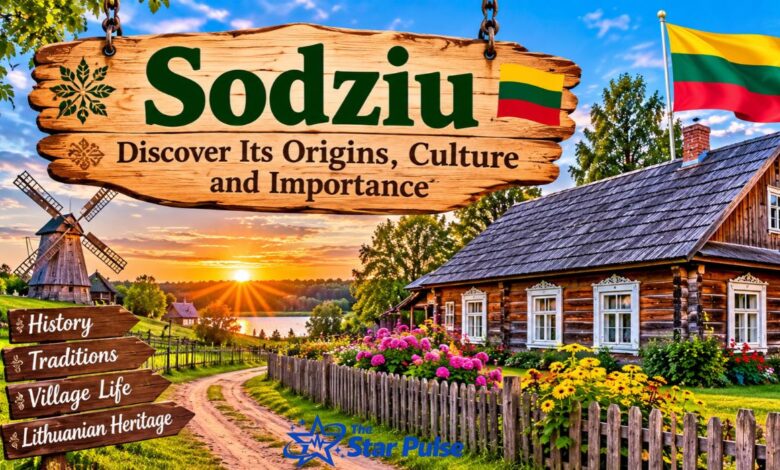
Sodziu is an interesting term connected with Lithuanian language, traditional villages, and rural cultural heritage. Although the word may appear unfamiliar to international readers, it has an important linguistic connection to Lithuania’s historical countryside. Its standard Lithuanian spelling is sodžius, which generally refers to a village or traditional rural settlement. The term also carries historical associations with farming communities, family homes, and agricultural lifestyles.
Understanding Sodziu means exploring more than a simple word. It provides an opportunity to discover how Lithuanian communities developed, how people organized their homes and farmland, and how traditional customs influenced everyday life. From historical settlement patterns to modern cultural preservation, Sodziu offers an interesting perspective on Lithuania’s identity and rural history.
What Is Sodziu?
Sodziu is commonly used as a simplified spelling of the Lithuanian word sodžius. The original spelling includes the Lithuanian character ž, which represents a distinct consonant sound. Its general meaning is village or traditional rural settlement. Depending on the historical context, it can also describe a farmstead or rural residence. The word is particularly interesting because it connects a physical location with the lifestyle of the people who lived there. Traditional settlements were closely associated with agriculture, family responsibilities, and community relationships. Unlike modern urban neighborhoods, these rural environments often developed around farmland, livestock, and household activities.
Linguistic Origins of Sodziu
The linguistic background of Sodziu is connected to Lithuanian, one of the Baltic languages. Lithuanian is widely recognized for preserving several ancient linguistic characteristics that interest language researchers. The correct dictionary form sodžius is important when studying its meaning and historical usage. Online searches sometimes remove special characters, resulting in spellings such as Sodziu. However, using the original Lithuanian spelling can provide more accurate dictionary results. It is also important not to confuse sodžius with žodžiu, which is related to žodis, meaning word. Although the expressions look somewhat similar, they have different meanings and linguistic uses.
Historical Origins of Traditional Sodžius Settlements
Traditional sodžius settlements developed as Lithuanian rural communities expanded and agricultural lifestyles became established. Historical accounts associate this type of settlement with approximately the twelfth to sixteenth centuries. During earlier periods, farming households increasingly established residences near the agricultural land they cultivated. As a result, some settlements developed with houses scattered across surrounding fields rather than arranged along one central street. This arrangement reflected the practical needs of farming families, who required convenient access to their land, animals, and natural resources. These historical patterns provide valuable information about how Lithuanian rural communities organized their living environments.
Traditional Village Organization
Traditional Lithuanian villages were influenced by agriculture, geography, and relationships between neighboring families. Houses were positioned according to available land, farming requirements, and local settlement customs. Some households lived relatively close together, while others were separated by fields and natural landscape features. Community cooperation was essential because farming involved demanding seasonal activities. Neighbors could exchange equipment, share agricultural knowledge, and support each other during harvest periods. This organization helped rural communities maintain social connections even when individual homes were spread across considerable distances. Sodziu therefore represents not only a type of settlement but also a historical way of organizing community life.
Agriculture and Everyday Life
Agriculture was central to traditional Sodziu life. Rural households depended on farming to produce food, maintain their economic stability, and support their families. Crops, livestock, gardens, and nearby natural resources played important roles in everyday activities. People followed seasonal routines that included preparing soil, planting crops, caring for animals, and collecting harvests. Farming knowledge was frequently transferred between generations through practical experience. Children learned household responsibilities while observing older family members working in fields and caring for animals. These activities created a strong connection between Lithuanian rural communities and their natural surroundings.
The Valakas Land Reform
The Valakas land reform was an important event in Lithuanian rural history. Beginning during the sixteenth century, this reform changed the organization of agricultural land and influenced village settlement patterns. Land was measured and reorganized, while agricultural holdings were divided into designated strips. This process encouraged more regular village arrangements, including settlements organized along streets. Earlier scattered homesteads were transformed in many locations as land organization changed. The reform also affected relationships between peasants, landowners, and agricultural production. Understanding this historical development helps explain why traditional Lithuanian settlements did not all have the same physical appearance.
Traditional Homes and Architecture
Traditional Lithuanian rural architecture is another important part of Sodziu heritage. A typical rural homestead could include a family dwelling, barns, storage buildings, and structures for keeping animals. Their arrangement depended on household needs, available land, and financial resources. Wooden construction was particularly common in many rural areas because timber was widely available. Buildings were designed primarily for practical purposes, including food storage, agricultural work, and household activities. Their layouts reflected the importance of farming and family life. Today, traditional Lithuanian architecture provides valuable historical evidence about the skills, materials, and lifestyles of earlier generations.
Family Traditions and Community Relationships
Family relationships played an important role in traditional village communities. Different generations often shared household responsibilities, agricultural knowledge, and cultural traditions. Older family members taught younger relatives practical skills such as preparing food, maintaining buildings, caring for animals, and managing farmland. Community celebrations and seasonal activities also helped strengthen relationships between households. Neighbors supported one another during agricultural work and important family occasions. Although traditions varied across Lithuania’s regions, cooperation remained an important feature of rural society. These relationships helped preserve local customs and cultural knowledge over generations.
Sodziu and Lithuanian Cultural Identity
Lithuanian cultural identity has been influenced by language, history, traditional occupations, and connections with the countryside. Rural communities helped preserve regional vocabulary, folk stories, songs, and customs. The word sodžius represents part of this historical linguistic heritage. It reminds people that traditional villages were important social environments where families developed relationships and maintained distinctive lifestyles. Rural heritage also connects modern generations with ancestors who depended heavily on agriculture and local resources. Today, traditional village terminology continues to appear in cultural discussions, historical research, and heritage education.
Difference Between Sodziu, Sodžius, and Kaimas
Understanding related Lithuanian words helps readers explore Sodziu more accurately.
-
Sodžius: A Lithuanian word associated with a village or traditional rural settlement.
-
Kaimas: The common modern Lithuanian word for village.
-
Sodyba: A homestead or farmstead, generally including residential buildings and associated property.
-
Žodžiu: A different Lithuanian expression related to žodis, meaning word.
These terms are connected through language and everyday life, but they are not interchangeable in every situation. Recognizing their differences makes linguistic research more accurate and prevents misunderstandings.
Sodziu in Modern Lithuanian Society
Modern Lithuania has experienced significant changes through urbanization, technological development, and changing agricultural practices. Many people now live in cities, while rural communities continue to contribute to the country’s economy and cultural landscape. Traditional villages have also attracted interest from people exploring countryside tourism, regional history, and historic architecture. Some traditional buildings and settlement patterns are preserved through museums and cultural heritage projects. In this environment, Sodziu remains relevant as a historical and linguistic concept. It provides a connection between contemporary Lithuanian society and the experiences of earlier rural generations.
Importance of Sodziu for Historical Research
Sodziu is an interesting subject for researchers because it connects multiple academic fields. Linguists can study its spelling, grammatical forms, and historical usage. Historians can investigate the development of settlements and agricultural reforms. Cultural researchers can examine family traditions and community relationships. Architectural researchers can explore traditional homesteads and construction methods. These different perspectives demonstrate why a single historical word can provide valuable information about society. Studying Sodziu also helps international readers understand how language preserves the experiences of earlier generations.
How to Explore Sodziu and Lithuanian Heritage
People interested in Sodziu can learn more through Lithuanian dictionaries, historical encyclopedias, academic publications, and ethnographic museums. Learning basic Lithuanian vocabulary is another useful step because original terminology often provides better historical context than translated descriptions. Researchers can also explore traditional village photographs, historical maps, and architectural collections to understand how settlements changed over time. It is important to distinguish documented historical facts from modern interpretations. Combining linguistic research with cultural and historical resources provides a more complete understanding of Sodziu and its importance in Lithuania.
Final Thoughts
Sodziu is more than an unfamiliar Lithuanian expression. Its connection with traditional villages, agricultural settlements, family relationships, and rural architecture makes it an important subject for understanding Lithuania’s cultural heritage. Its historical development demonstrates how farming practices, land reforms, and community relationships influenced rural life. Understanding the original word sodžius also helps readers distinguish it from related Lithuanian expressions such as kaimas and sodyba. For anyone interested in Lithuanian history, language, and traditional village culture, Sodziu offers a meaningful starting point for discovering the country’s rural past.
FAQs
1. What does Sodziu mean?
Sodziu is a simplified spelling associated with the Lithuanian word sodžius, which generally means village or traditional rural settlement. Depending on historical context, it can also refer to a farmstead or rural residence.
2. Is Sodziu a Lithuanian word?
Yes. Its standard Lithuanian dictionary form is sodžius. The spelling Sodziu is commonly used online without Lithuanian diacritical marks. The original spelling is recommended when researching Lithuanian vocabulary and historical documents.
3. What are the historical origins of Sodziu?
Traditional sodžius settlements are associated with the development of Lithuanian farming communities, particularly between approximately the twelfth and sixteenth centuries. Their development reflects changing agricultural practices and household arrangements.
4. What is the difference between Sodžius and Kaimas?
Both words relate to villages. However, sodžius has particular historical associations with traditional rural settlements, while kaimas is the commonly used modern Lithuanian word for village.
5. Why is Sodziu important to Lithuanian culture?
Sodziu represents an important connection to Lithuanian rural heritage. It helps explain traditional settlement patterns, agricultural lifestyles, family relationships, and historical language. Studying it provides insight into how rural communities influenced Lithuania’s cultural identity.